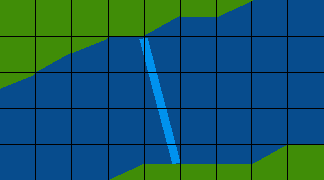
I designed the map to fit comfortably on a ping-pong table, 9' x 5'. I wanted to make modular terrain for greater flexibility, so I arbitrarily chose a tile size of 1' x 1' and overlaid a grid of the proper scale over the map in Coski's book (see Sources, below). This gave a map schematic looking like this:
This is actually a bit small, as the Confederate ships grounded slightly offmap to the west. It might have been better to shift the grid a column or two left, which would allow the Confederates to be in their proper places. Plus it would be more visually interesting, as the river is only 1.5 squares wide two columns to the west of what's depicted here. Of course, if your table is larger than a ping-pong table, then off you go.
The light blue line is the Union obstructions. Historically,
Fredericksburg had cut away some of the booms on the northern
end, which is why I only put the line halfway out for my game.
I didn't worry about shallows too much, but given the historical Confederate problems with running aground, maybe some shoals would be appropriate. It should probably be noted that I ignored Smoke on the Water's 3-strikes-and-you're-out grounding rule, both for play balance reasons and because historically there was a rising tide at dawn an that is what eventually freed the stuck ships.
| Ship name | Class | Type | Thoroughbred Model | |||
| Fredericksburg | - | Ironclad | TS45 | |||
| Richmond | Richmond | Ironclad | TS14 | |||
| Virginia II | - | Ironclad | TS52 | |||
| Hampton | Maury Gunboat | Wooden | TS67 | |||
| Nansemond | Maury Gunboat | Wooden | TS67 | |||
| Drewry | - | Armed Tender | TS20(?) but had two guns | |||
| Torpedo | - | Armed Tender | TS20(?) but had two guns | |||
| Beaufort | - | Armed Tug | TS20 | |||
| Hornet | Squib | Torpedo Boat | TS44 | |||
| Wasp | Squib | Torpedo Boat | TS44 | |||
| Scorpion | Squib | Torpedo Boat | TS44 |
| Ship name | Class | Type | Thoroughbred Model | |||
| Onondaga | - | Double-turreted monitor | TS10 | |||
| Hunchback | - | Sidewheel steamer | TS33 | |||
| Massasoit | Sassacus | Sidewheel steamer | TS33 (but should be half again as big as Hunchback!) | |||
| Spuyten Duyvil | - | Experimental Torpedo Boat | TS44 (but it's not even close to this one-of-a-kind ship, really) |
I've tried this scenario three times now and while the steps along the way have differed entertainingly, the end result always seems to be the same: wooden ships are sunk, Onondaga manhandles the Confederate ironclads, while Virginia II zips off the map with some minor damage. It seems to me like the situation is inherently tilted slightly towards to Union.
I used the player options (see the Player Notes) to allow the players to perform
a bit of self-balancing. I told the players that they could pick as many options
as they wanted, but then the victory evaluation would be weighted on the ratio of
options taken vs the historical level. In practice, neither side wanted to load
up with options. I'm not sure whether it was an unwillingness to complicate things
(many were first-time players) or an intentional strategy to increase chances of victory.
At any rate, were I to do it again I might just say both sides could
pick 8 (or whatever) points.
I've read enough history that two things in our battle rather bothered me. Not enough to ruin the fun, mind you, but they did make me do some further research.
First, the speed of Virginia II seems most suspicious. If you research her stats, "speed: 10 knots" keeps cropping up. Looking at the other Confederate ironclads, most were closer to 6 knots than to 10. The Atlanta had good engines taken from the blockade runner Fingal and she didn't make ten knots. Additionally, Virginia II had thicker armor (and so heavier, and so slower) than most other Confederate ironclads. So what gives?
I believe the source for "10 knots" is an intelligence report from a Confederate deserter in the Official Records of the Navy in the War of the Rebellion, specifically Vol XI p.381. But that informant didn't actually serve on Virginia II, and other interrogations (p. 382) say that Richmond was the same speed as Virginia II -- but no one claims that tubby Richmond was a 10 knot ship.
So overall I'm rather inclined to discount this evidence and feel Virginia II should be downgraded to 6-9 knots. Using Smoke on the Water rules, she goes from "Fast" to "Medium".
The second thing that bothered me was the relative ineffectiveness of
Onondaga's 15" smoothbore guns (SHSB in Smoke on the Water terms).
Historically, one hit with these knocked in Virginia II's end armor (8" backed by wood,
SH in Smoke on the Water) but in the game the smoothbores have too little
range and penetrating power to recreate history there. It seems backwards to
me when the Confederates are fearing the 11" rifles rather than the 15" smoothbores
in the monitors.
Coski, John. Capital Navy. Savas Publishing Company, 1996. Well-written account of the James River Squadron. Maps are few but excellent. Includes ironclad plans by David Meagher. Highly recommended.
Konstam, Angus. Confederate Ironclad. Osprey, 2001. The usual Osprey treatment. Looks nice, but take everything with a grain of salt. Everything. It's cheap for a reason.
Silverstone, Paul. Civil War Navies. Naval Institute Press, 2001. Your standard encyclopedia-of-ships tome. Useful for tracking down the wooden vessels. Stats for the Confederate ironclads vary with what I've seen published elsewhere. Has picture of Spuyten Duyvil. Useful.
Still, William Jr. Iron Afloat. University of South Carolina Press, 1985. The standard guide to the Confederate ironclads (though no mention of the European ironclads like Stonewall. Surprisingly, devotes a few pages (out of only 250) to Trent's Reach. Good book, but out of print.
The Ironclads and Blockade Runners web site is excellent, and you can't beat the price.
Battle Report | Union Player Notes | Confederate Player Notes