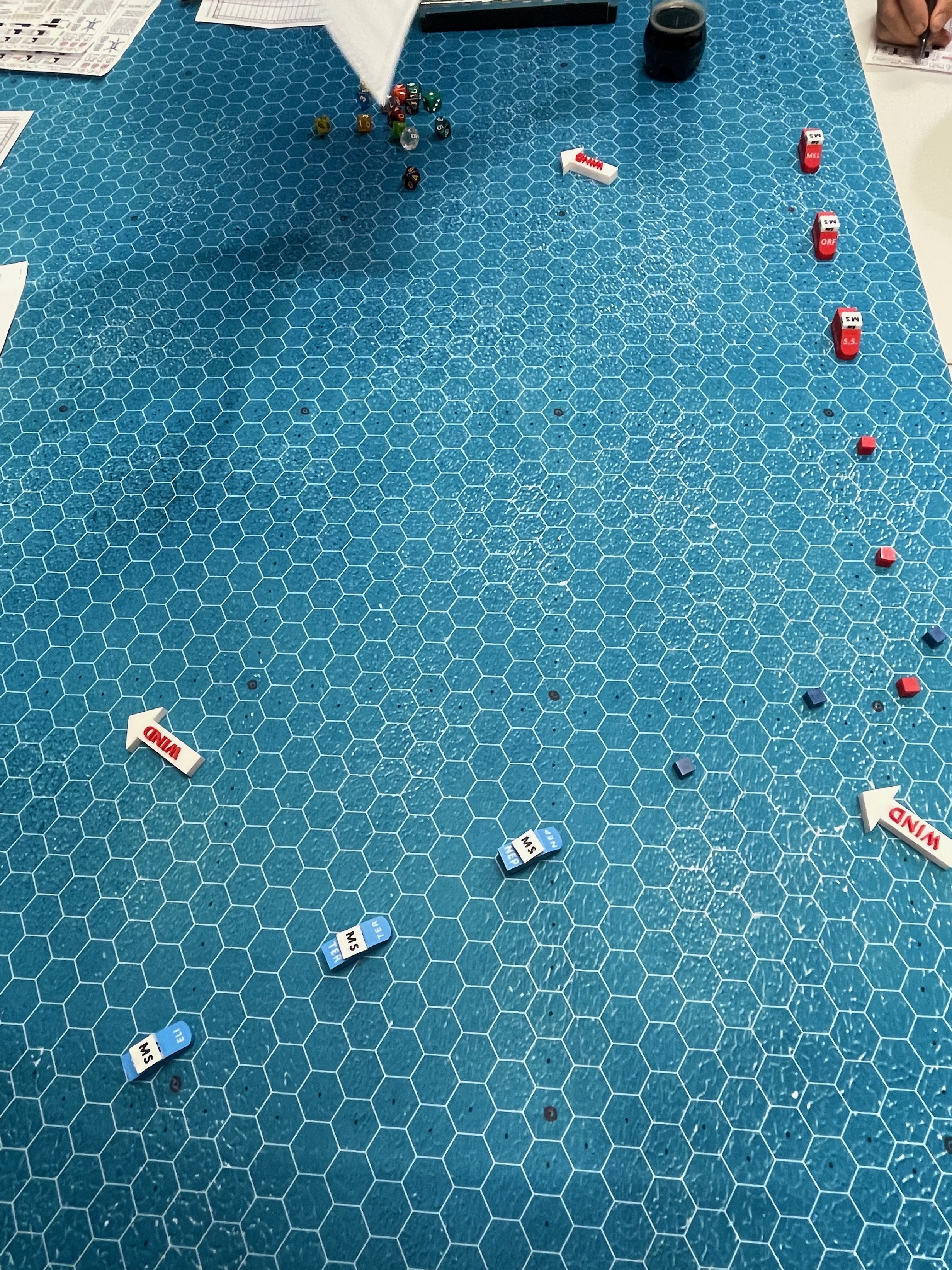
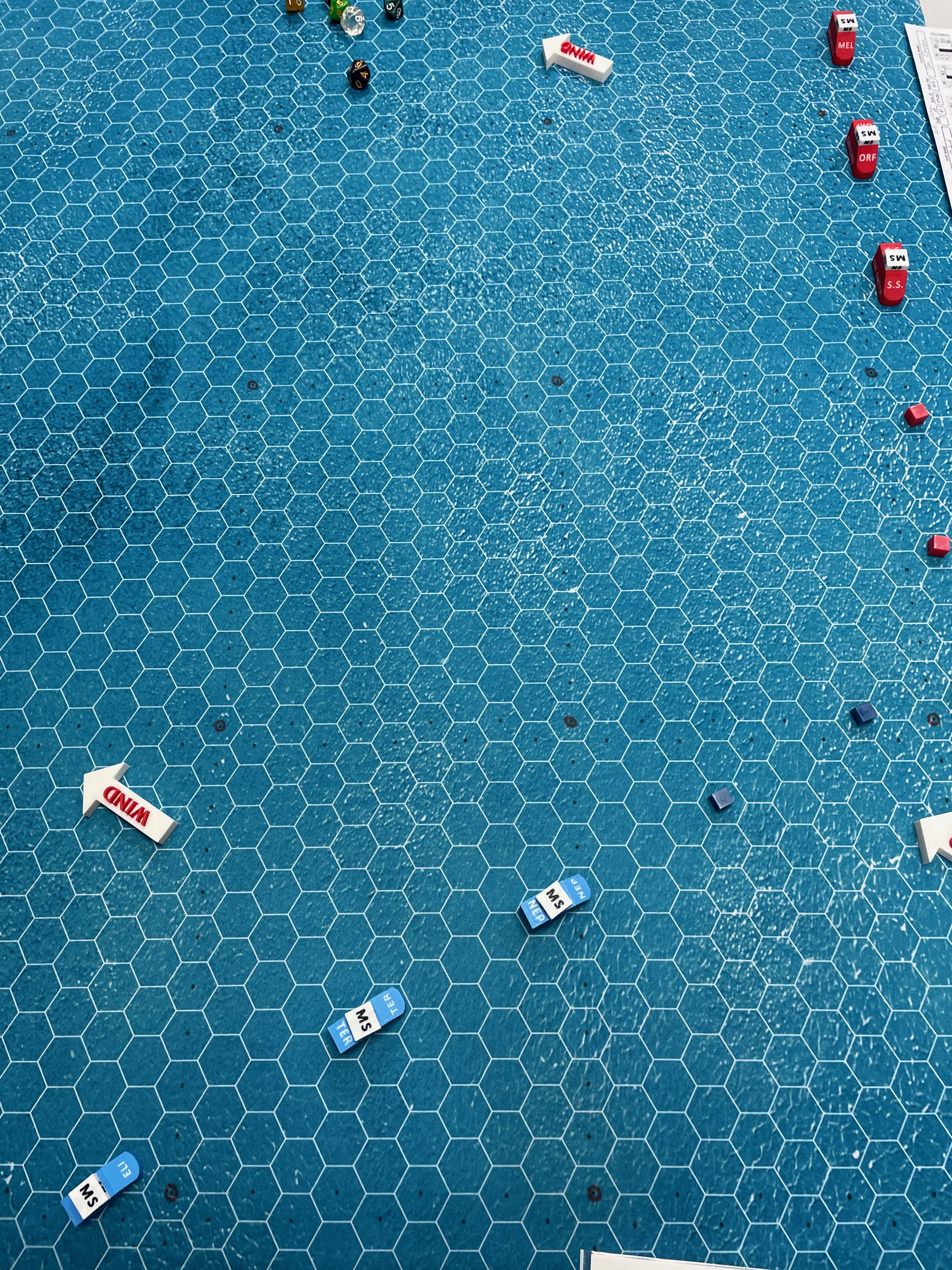
NOVA Close Action group game of scenario FT-06 from the Free Trade and Sailors' Rights module.
This is a hypothetical scenario from the War of 1812. The Shannon vs Chesapeake match is pretty well-known among Age of Sail fans. This scenario expands on that duel, positing that Broke's challenge is accepted earlier, with the result being a meeting between two small squadrons.
This is a pure victory points scenario: whoever has the most wins.
(Click on any image to see an enlargement.)
On the American side (blue blocks) are, left to right, Congress (38), Chesapeake (38), and President (44).
The British squadron (red blocks) is, top to bottom, Tenedos (38), Nymphe (38), and Shannon (38).
The ship names participating in the battle didn't match our equipment. It was confusing during the game trying to remember which ship was which, so for purposes of this battle report from now on I will use the block names rather than real ship names. Here's a table showing the real ship name and the block abbreviation representing it:
| Ship Name | Block |
| President | NEP |
| Chesapeake | TER |
| Congress | ELI |
| Shannon | S.S. |
| Nymphe | ORF |
| Tenedos | MEL |
The white "MS" blocks atop the ships indicate that they are at Medium Sail.
I game mastered this session, so I have no particular insight into the actions of any of the ships.
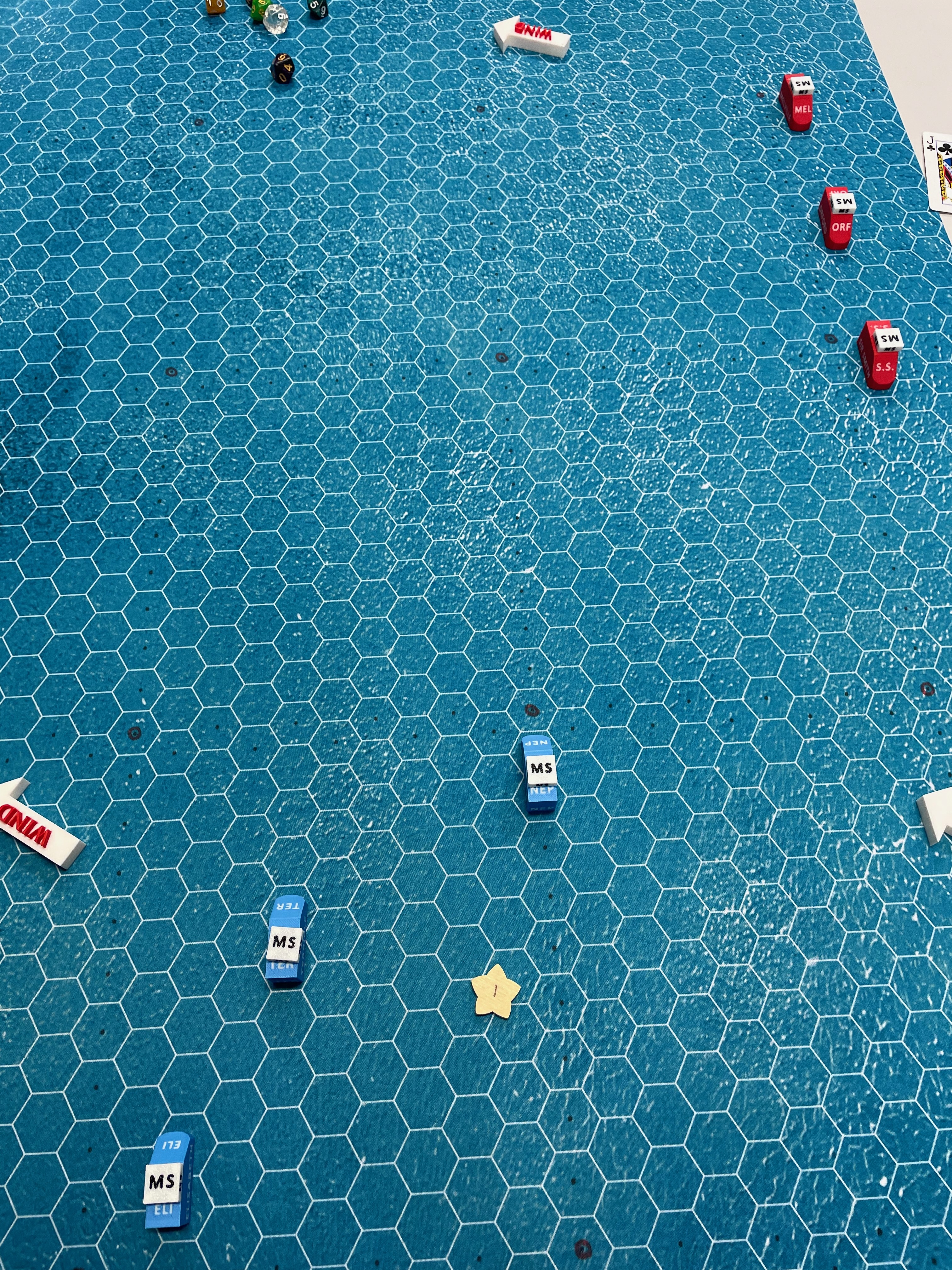
The British continue ahead close-hauled. The Americans turn broad-reaching.
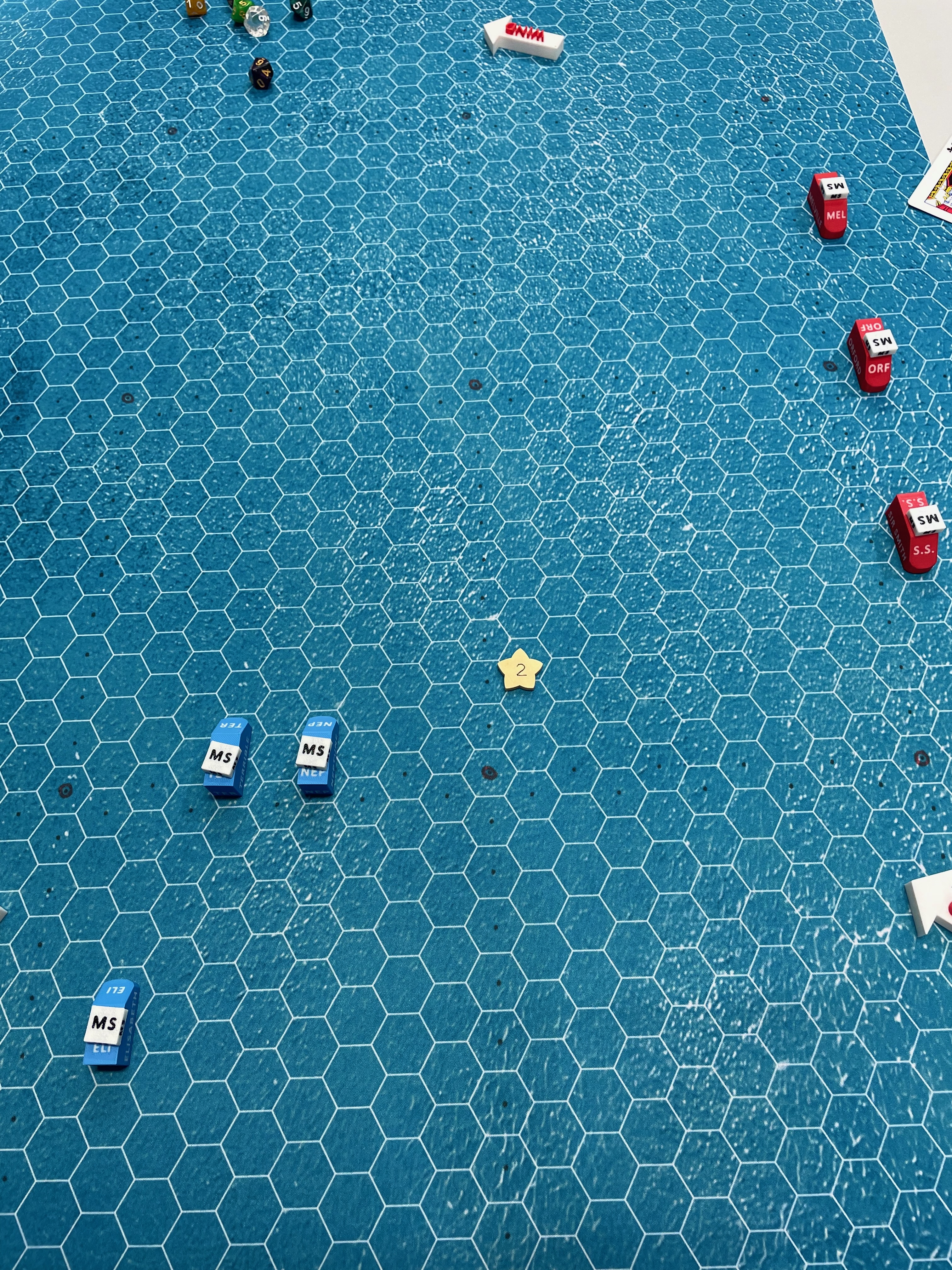
The Brits continue to await developments. Neptune slips left to begin reforming a line.
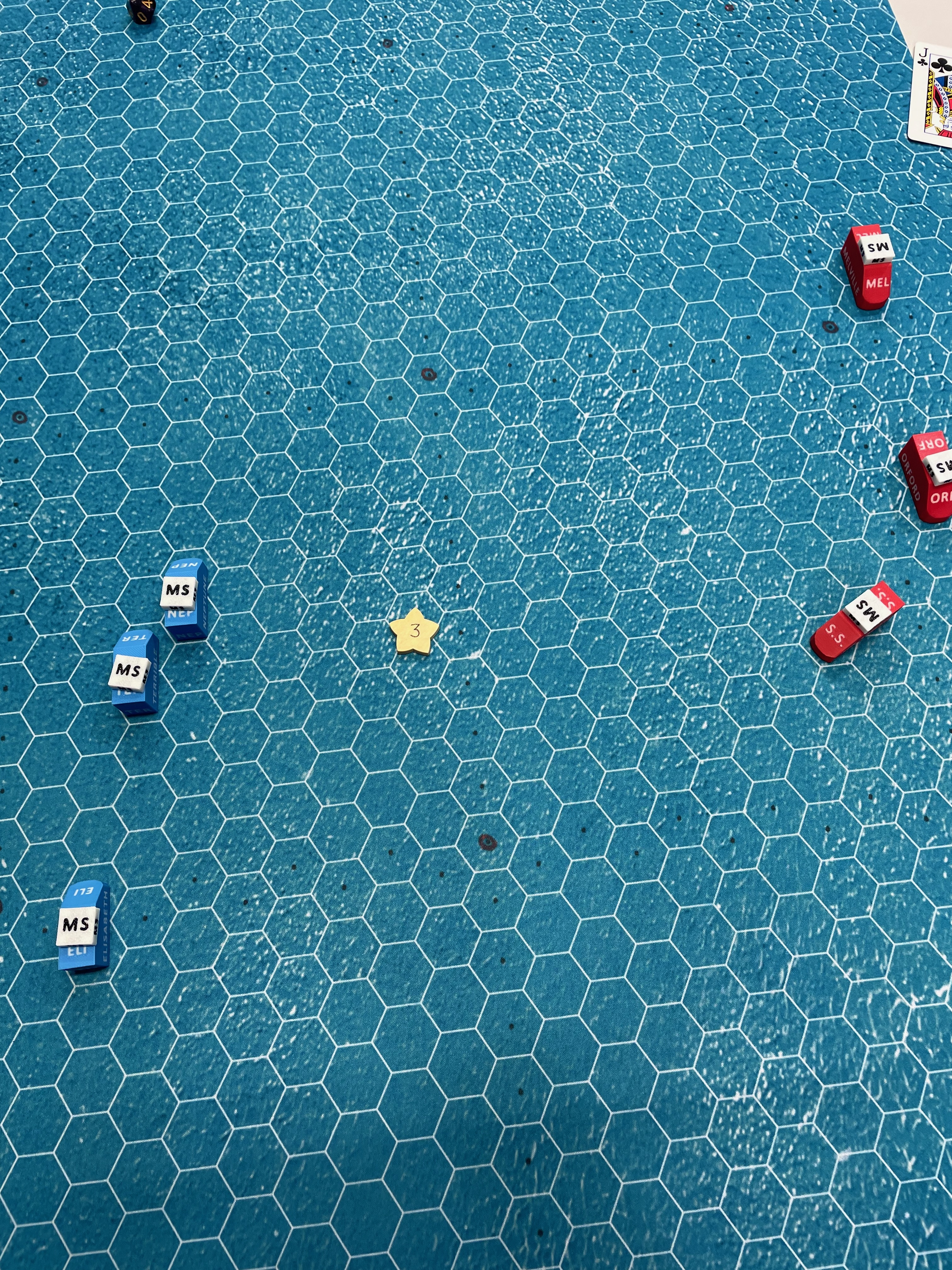
The British turn, presumably to get behind the Americans, who continue to form their line.
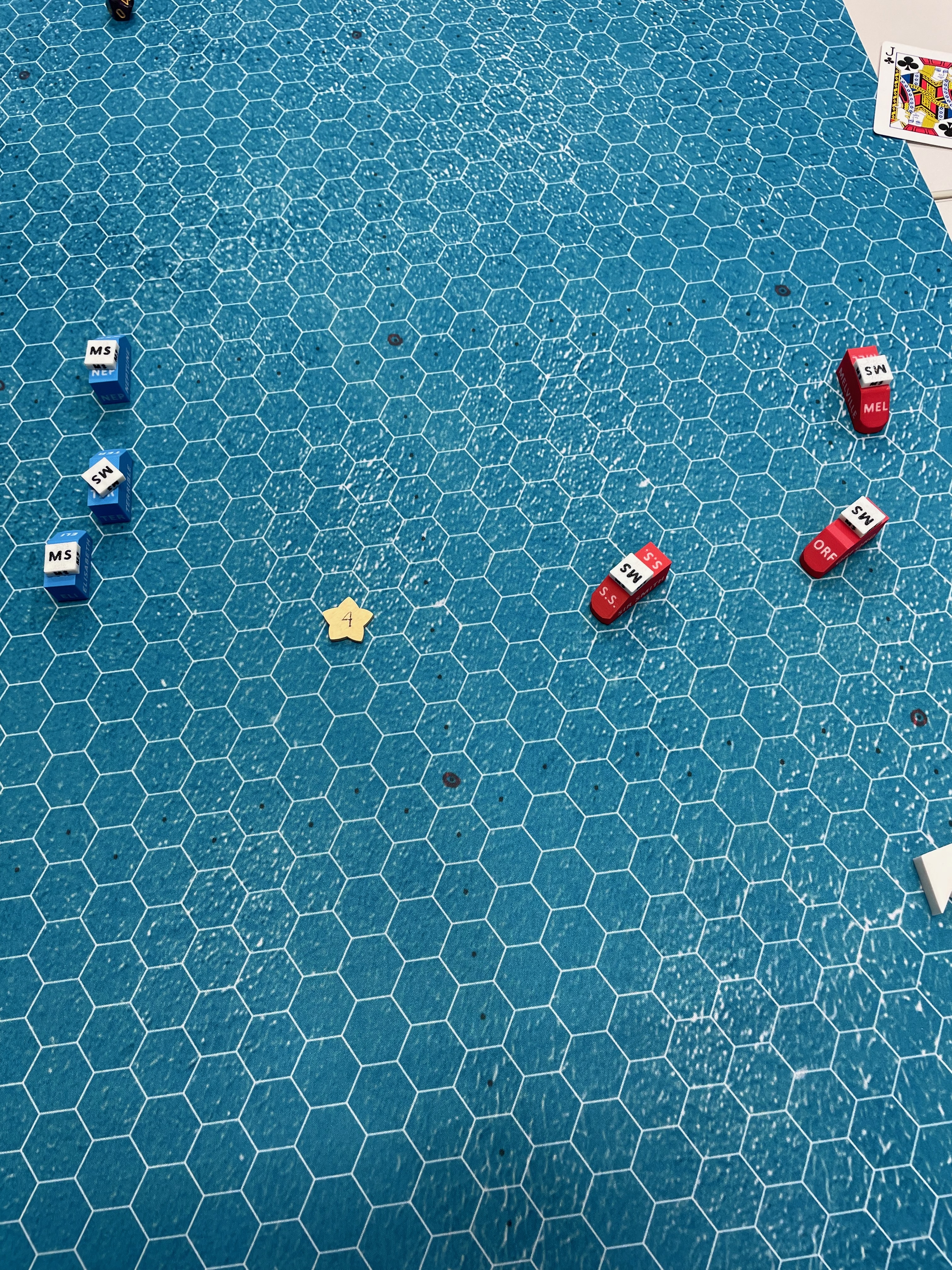
The American line is getting there. The British continue their turn in succession, Sir Smith slipping downwind to close the range.
Gunnery begins as Sir Smith targets Neptune, while Terrible and Elizabeth return fire. Initial dierolls favor the British as Neptune loses two rigging boxes to Sir Smith's one.
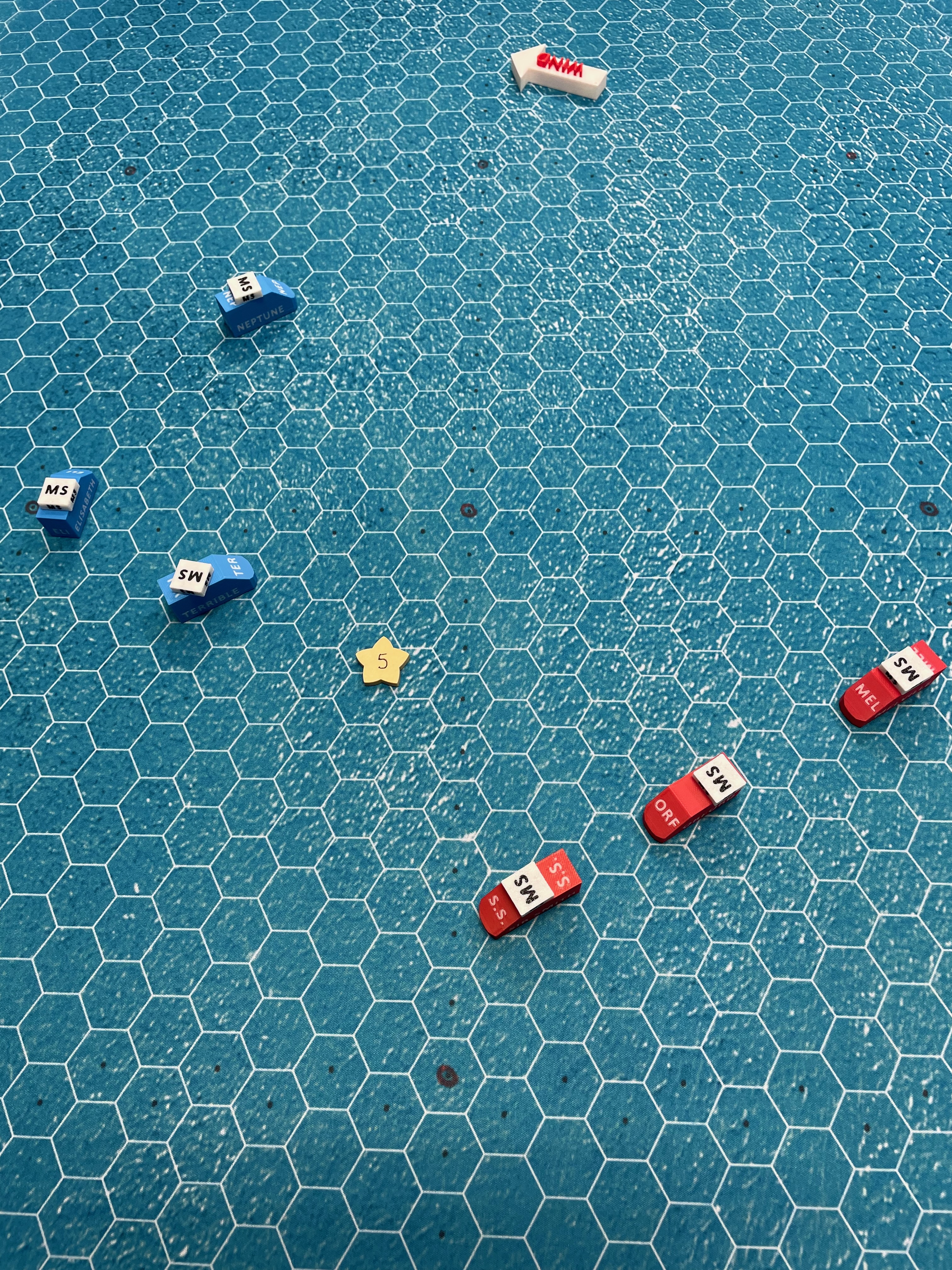
The British are back in their line, and now it's the Americans who begin turning their line close-hauled.
Sir Smith and Terrible exchange broadsides, the latter losing a rigging and crew and the former escaping unscathed.
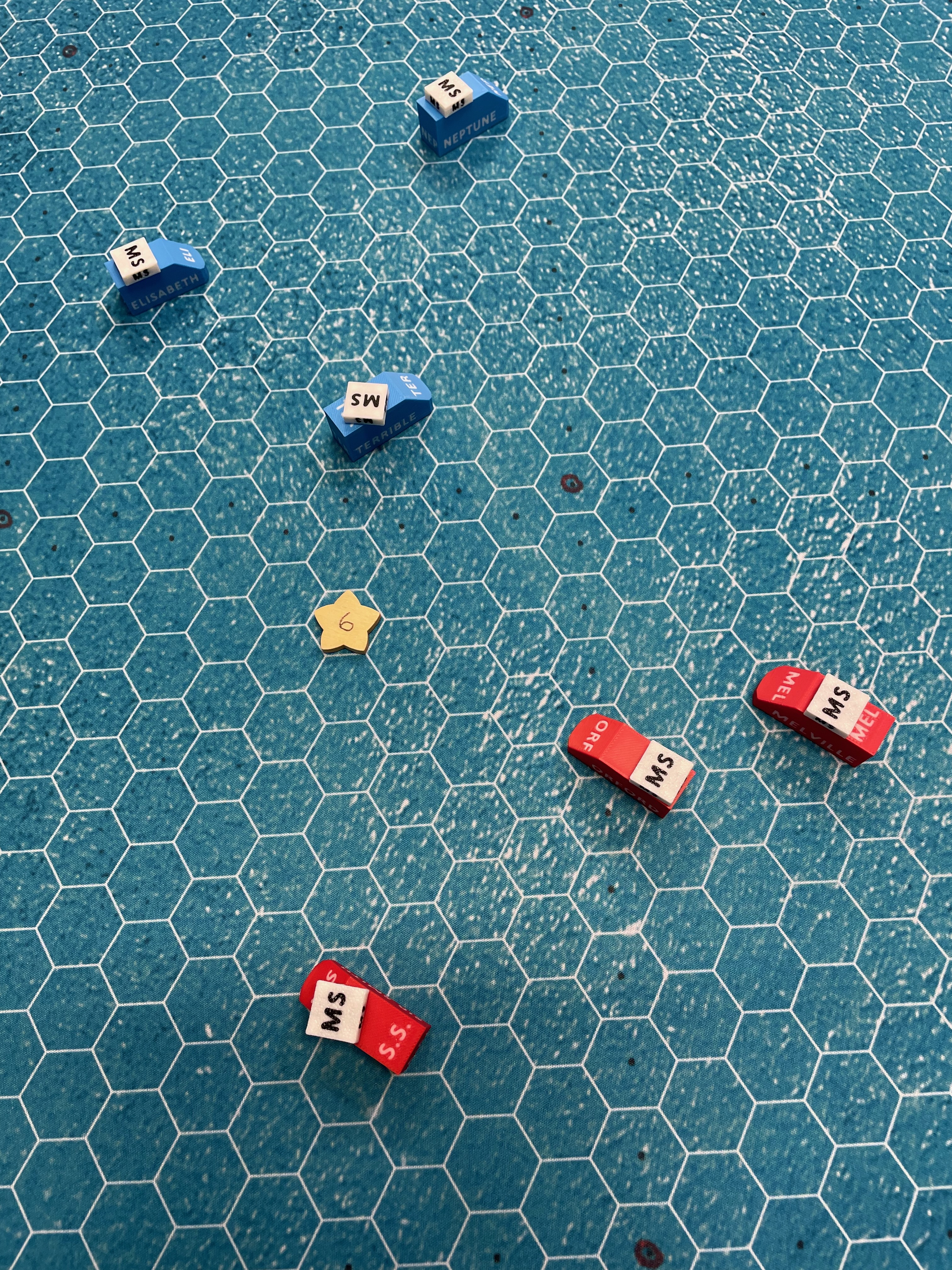
The British continue to try to get behind the Americans. Terrible is the only ship with any kind of shot. She switches targets to Orford and knocks off a rigging box.
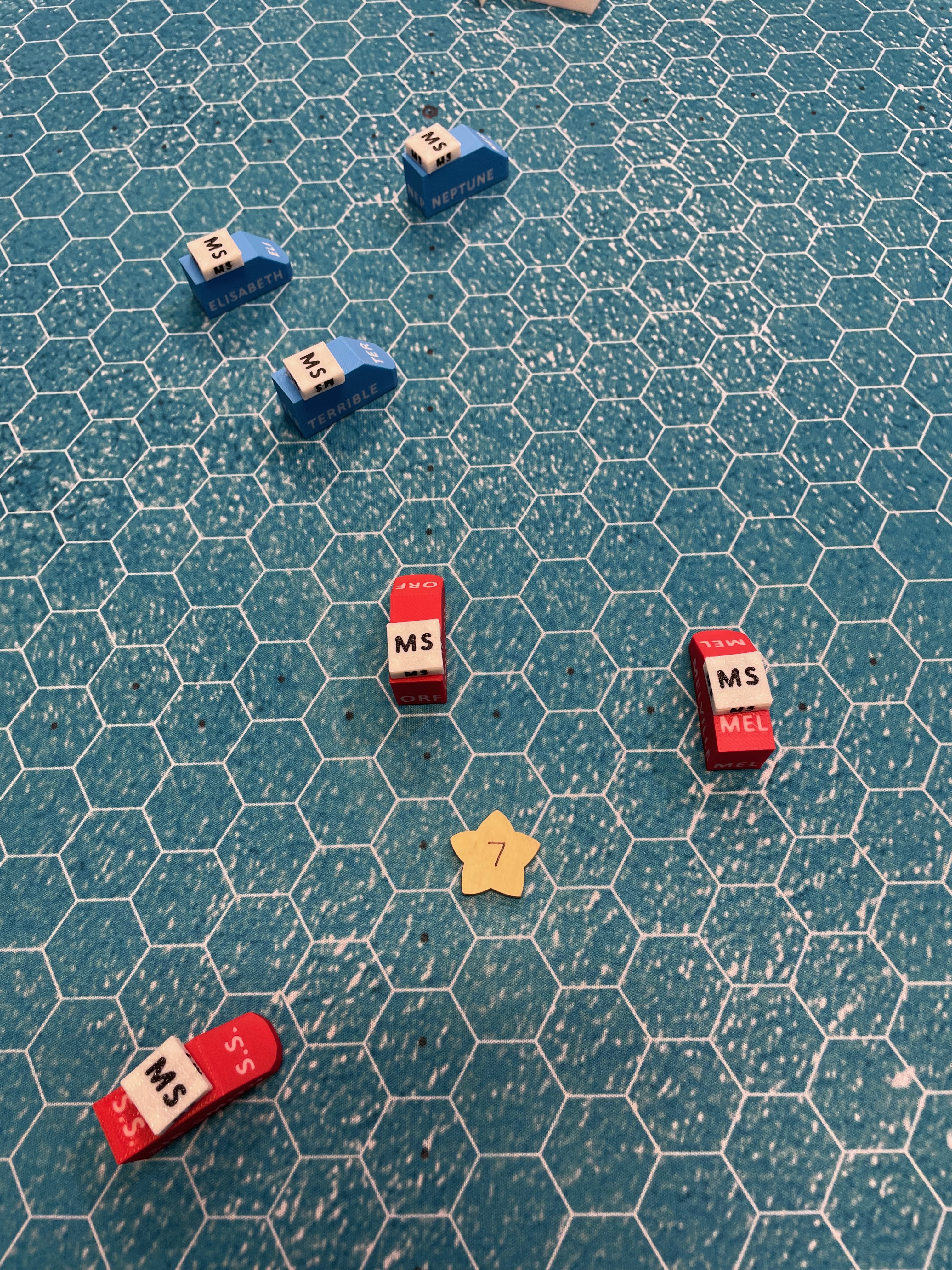
The Americans begin tightening up their formation and the British pursue.
Neptune opens fire on Melville and scores two rigging hits.
Terrible continues to pound Orford, the shortened range, carronades and rake nearly doubling her gunnery number from 15 last turn to 28 this turn. The effects are correspondingly improved, with Orford losing two rigging, a hull, and a sailor.
Sir Smith takes a cheeky half-broadside shot on Terrible. Her elite "A" crew and a bit of luck land a hull hit.
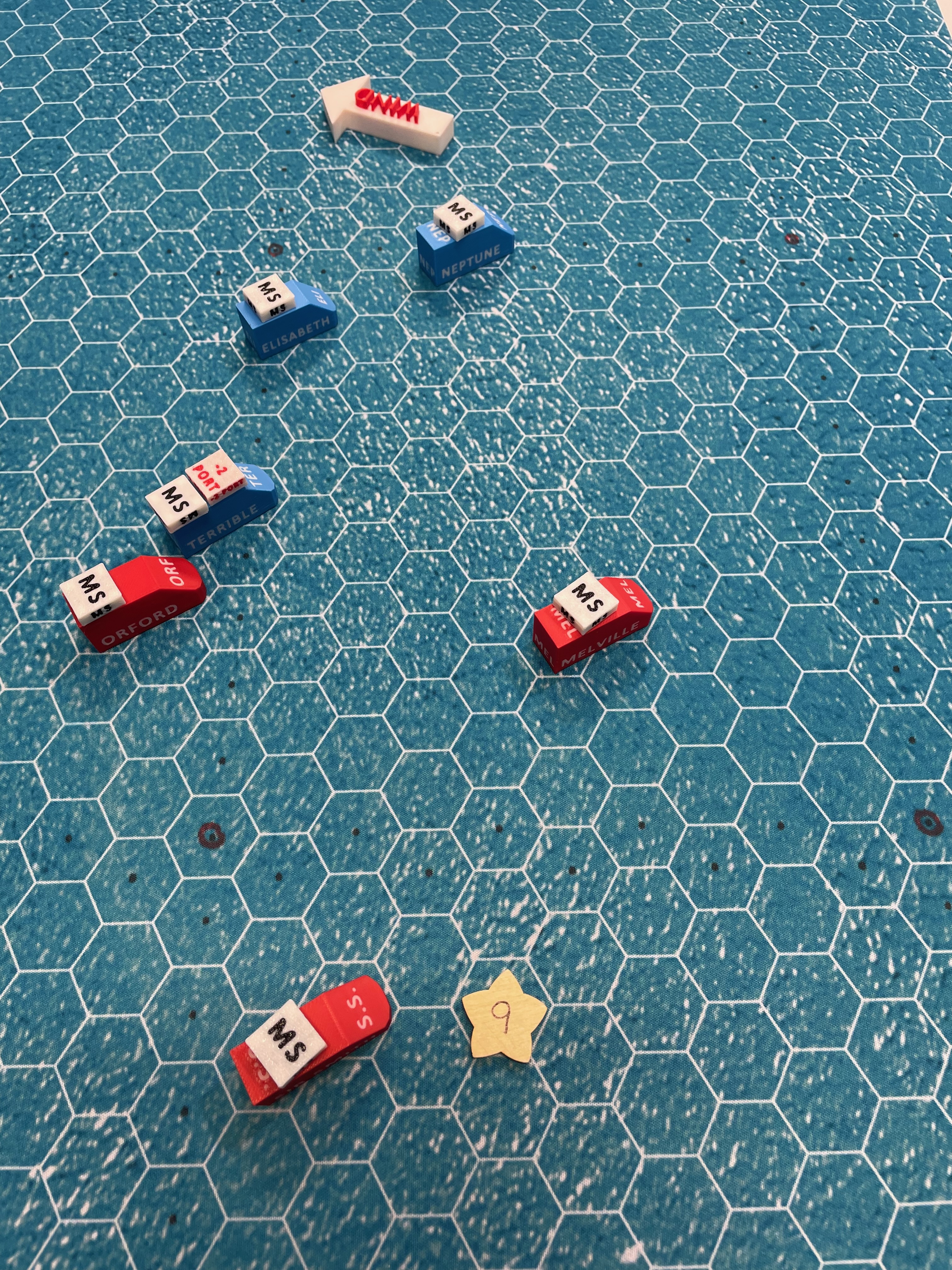
Ignore the "9" on the turn number star, which is just photographer error.
The Americans continue attempting to form their line. Orford boldly sails ahead and runs into Terrible, but successfully bears off.
Every ship has a shot on this bloodiest turn so far. Orford and Melville concentrate their fire on Terrible, which takes three rigging and two hull hits and gets some port guns obscured by falling rigging. Sir Smith gets a sailor hit on Elizabeth.
Returning fire, Neptune and Elizabeth hit Melville for a hull box and a sailor box, while Terrible returns Orford's compliments for one hit each on rigging, hull, and sailors.
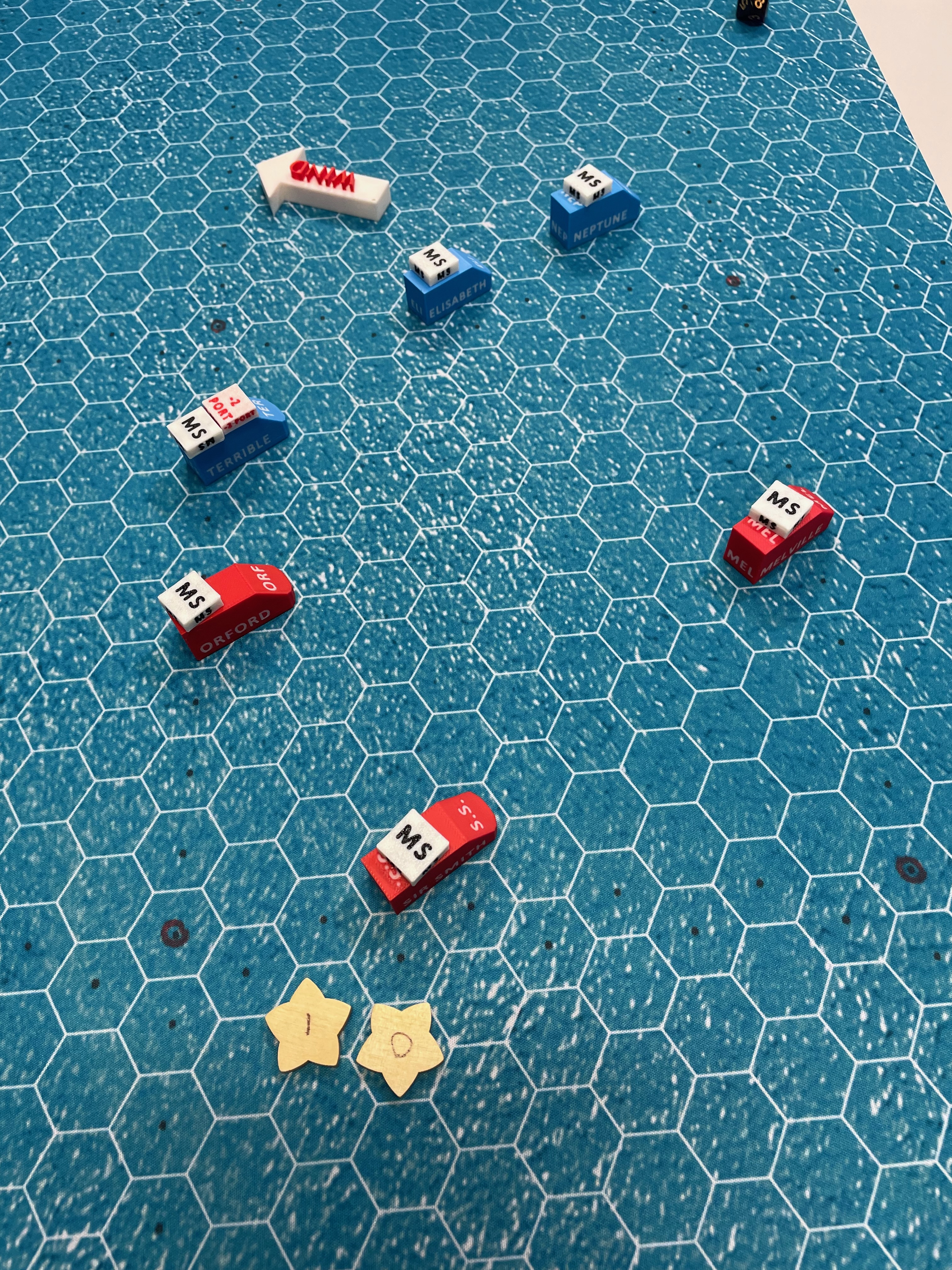
Again ignore the "10" on the turn number stars. Another photographer error.
The Americans have reformed their line. The first section losses occurred this turn, as Terrible loses her first rigging section and Orford her first sailor section.
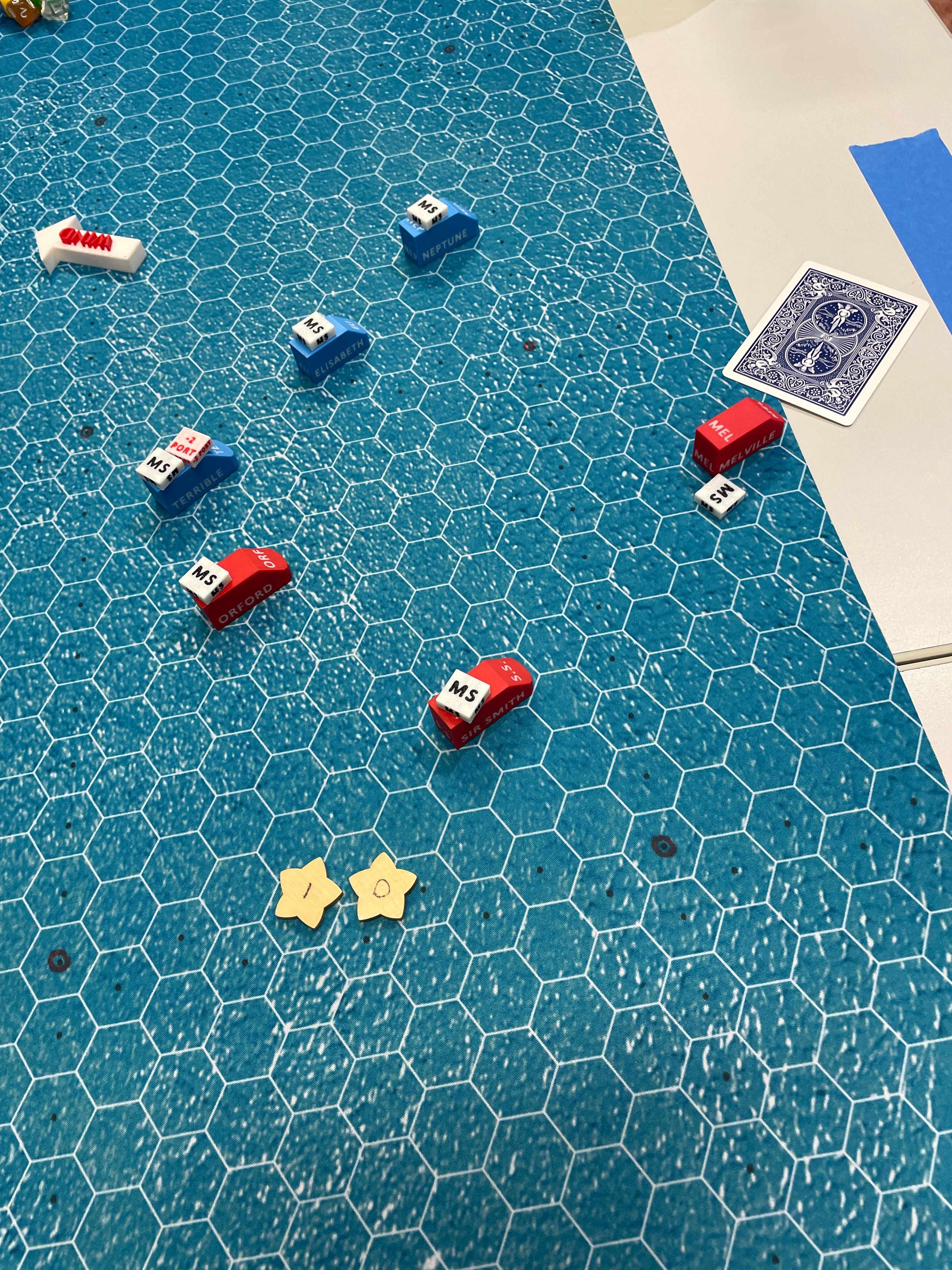
The turn number stars are finally back to correct. Both sides continue close-hauled to the board edge. Melville's switches to fighting sail, perhaps to help avoid going off the edge of the world.
Continuing their ongoing duel, Terrible and Orford both lose their first hull sections. The remaining British concentrate their fire on Elizabeth and get two rigging and a hull hit, while the other two American ships bombard Melville for a rigging, a hull, and a sailor box.
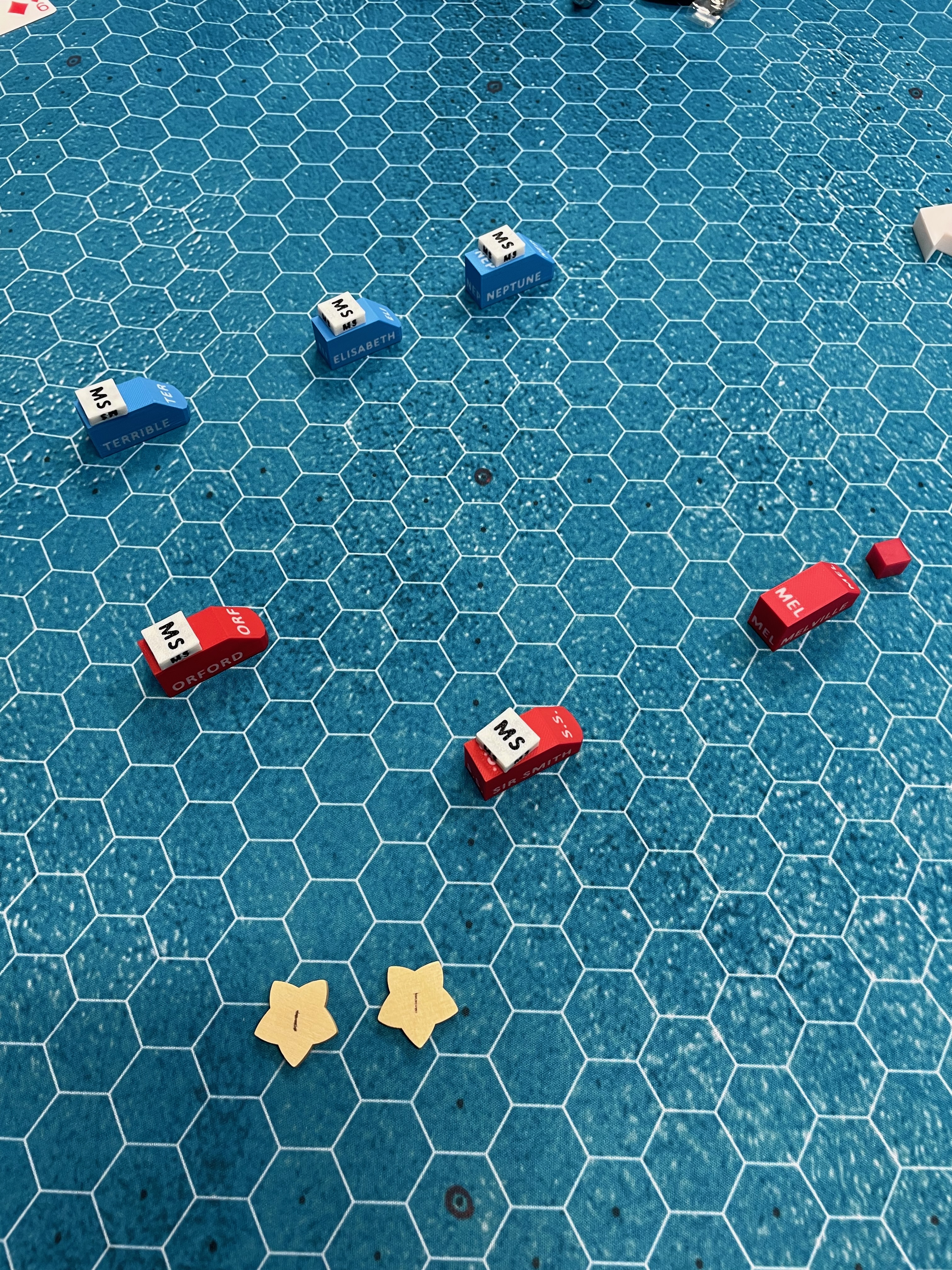
The lines continue close-hauled. Everyone continues firing at their previous target. Orford loses her first rigging section, while Melville loses her first rigging section and her first sailor section.
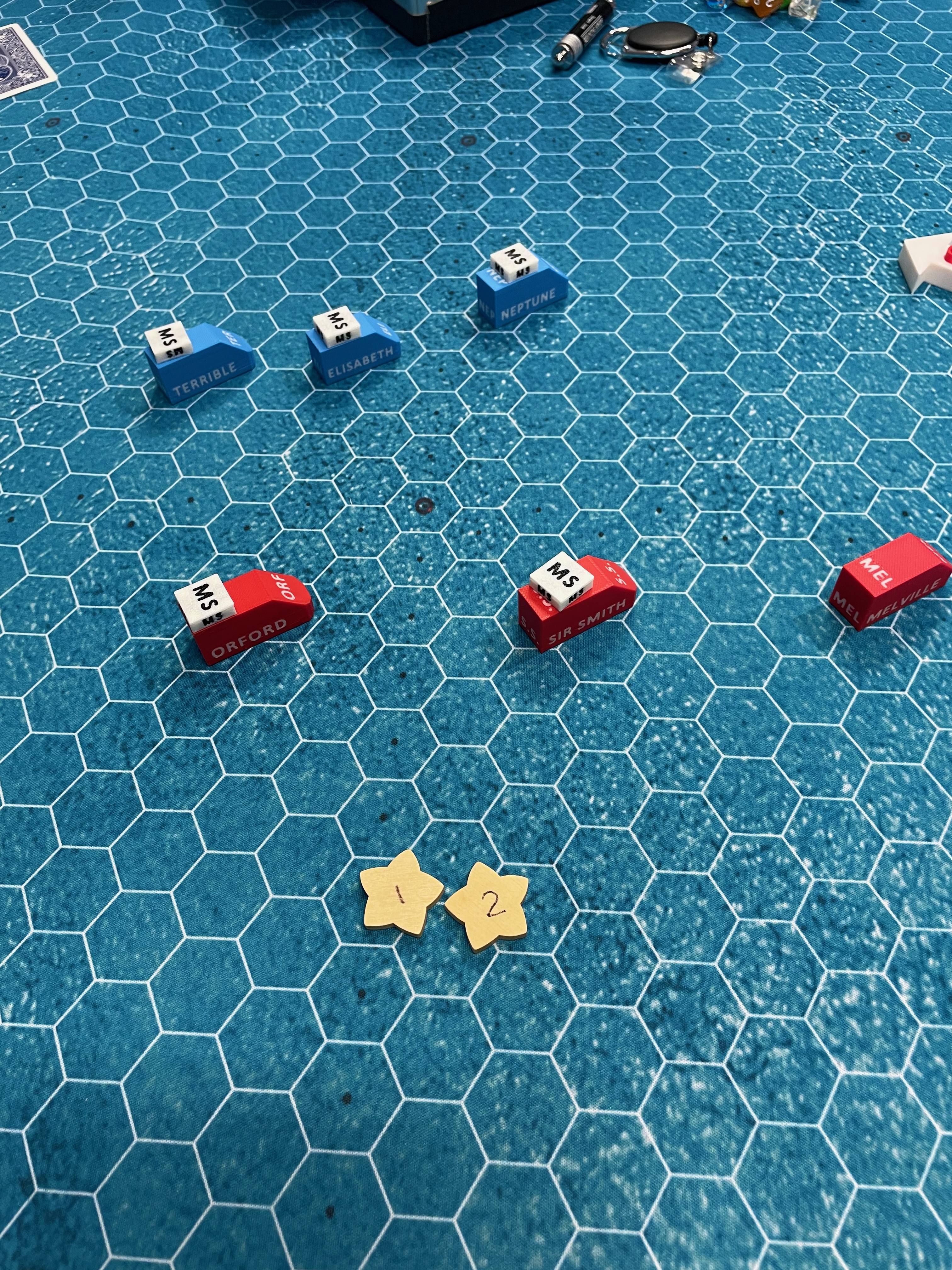
The British line starts to tighten. The broadsides continue, with Elizabeth and Neptune switching their fire from Melville to the closer Sir Smith, who has taken little damage so far but now loses two rigging, a sailor and a marine box. Orford and Elizabeth lose a hull boxes, and Terrible loses a marine box.
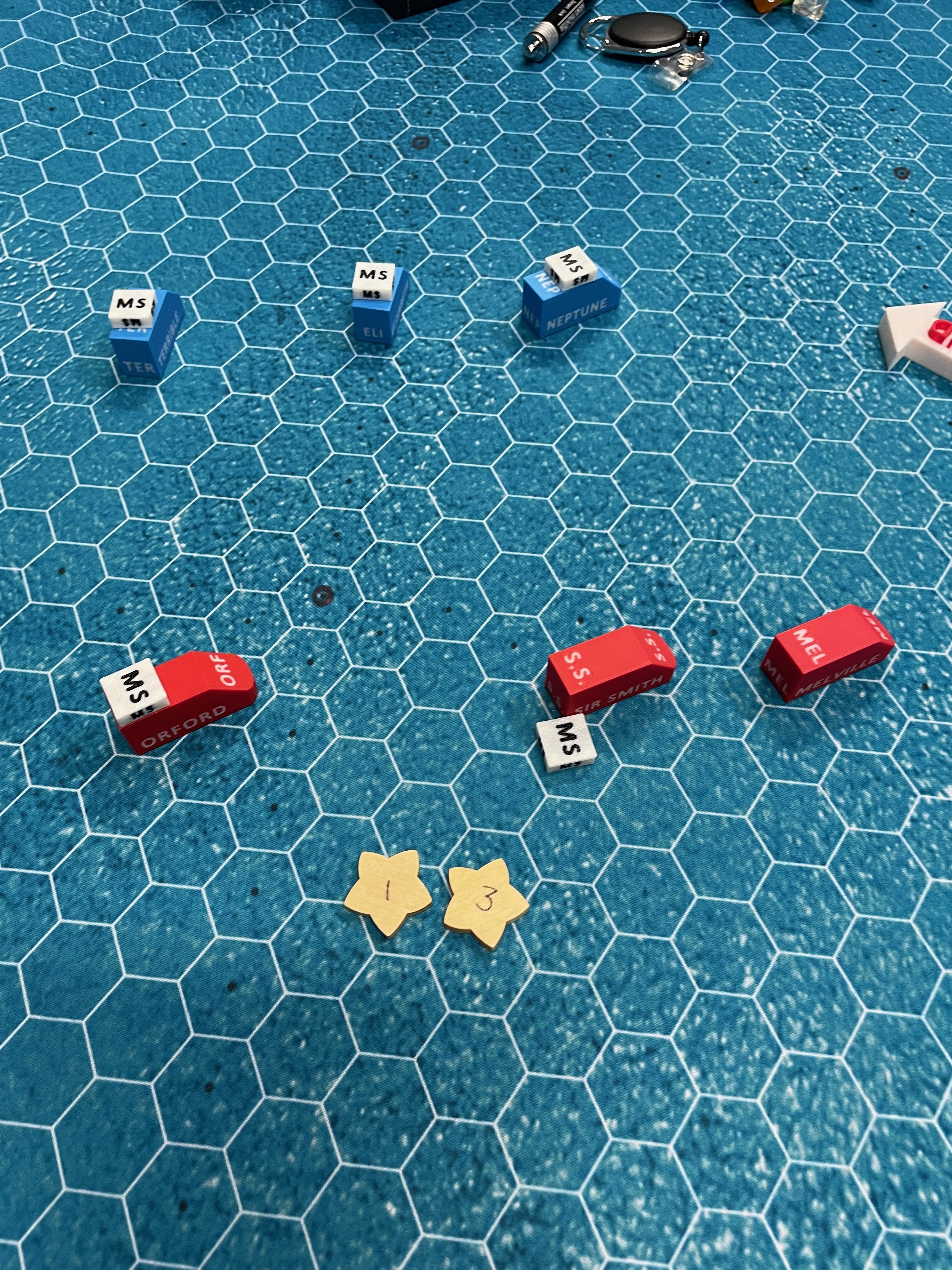
The Americans begin reversing their line. Sir Smith's goes down to fighting sail. Complementing Sir Smith's situation last turn, the mostly untouched Neptune now gets the attention of Sir Smith and Melville and takes two hull hits. Orford fires on the retreating Terrible for one hull hit.
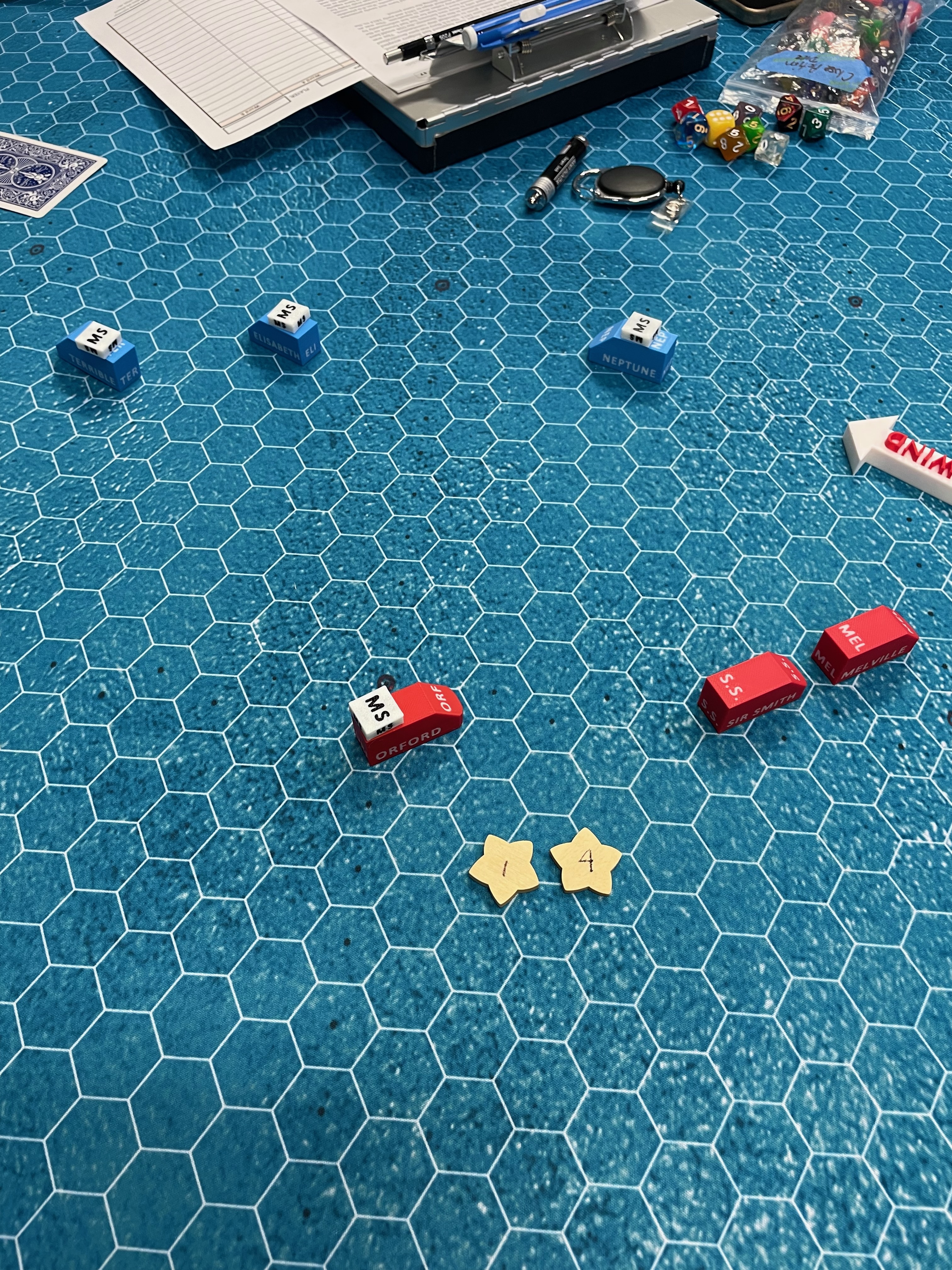
The Americans continue to open the range while the British van gets dangerously close to one another. Orford receives a lone rigging hit courtesy of Neptune, but the latter gets the worst of gunnery exchange this turn as the other British ships inflict one each rigging, hull, and sailor boxes. Orford takes a 1-High potshot at Elizabeth and despite the odds manages to land a rigging hit!
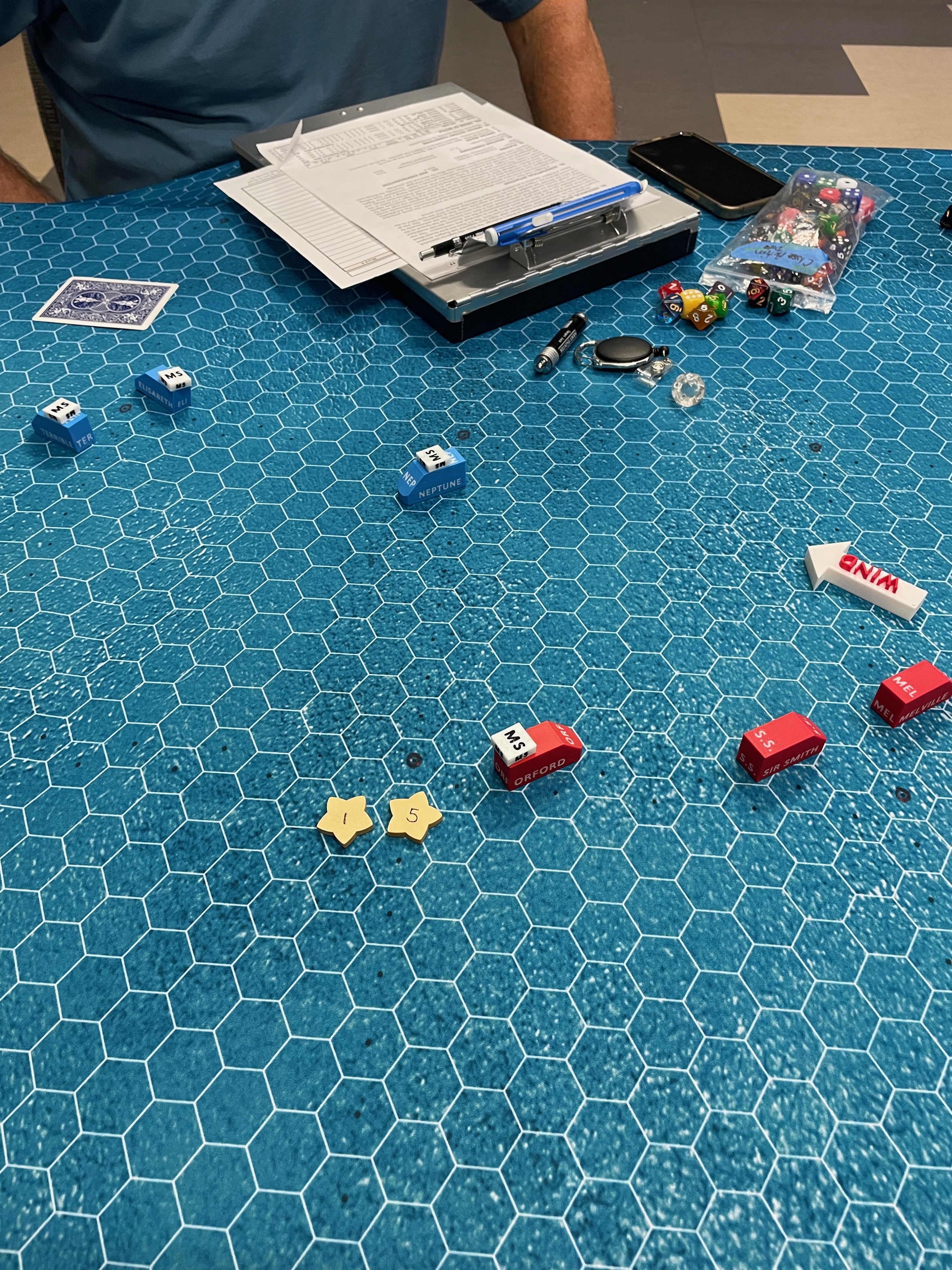
Neptune moves to fend off the British while the other American ships save themselves.
All three British ships fire at Neptune, but the opening range and well as section losses and fatigue are gradually reducing effectiveness and Neptune suffers just two rigging hits. She returns fire at Orford, being both closest and most damaged, and hits a sailor box.
Melville has had her marines repairing rigging for enough turns now to restore her first rigging section.
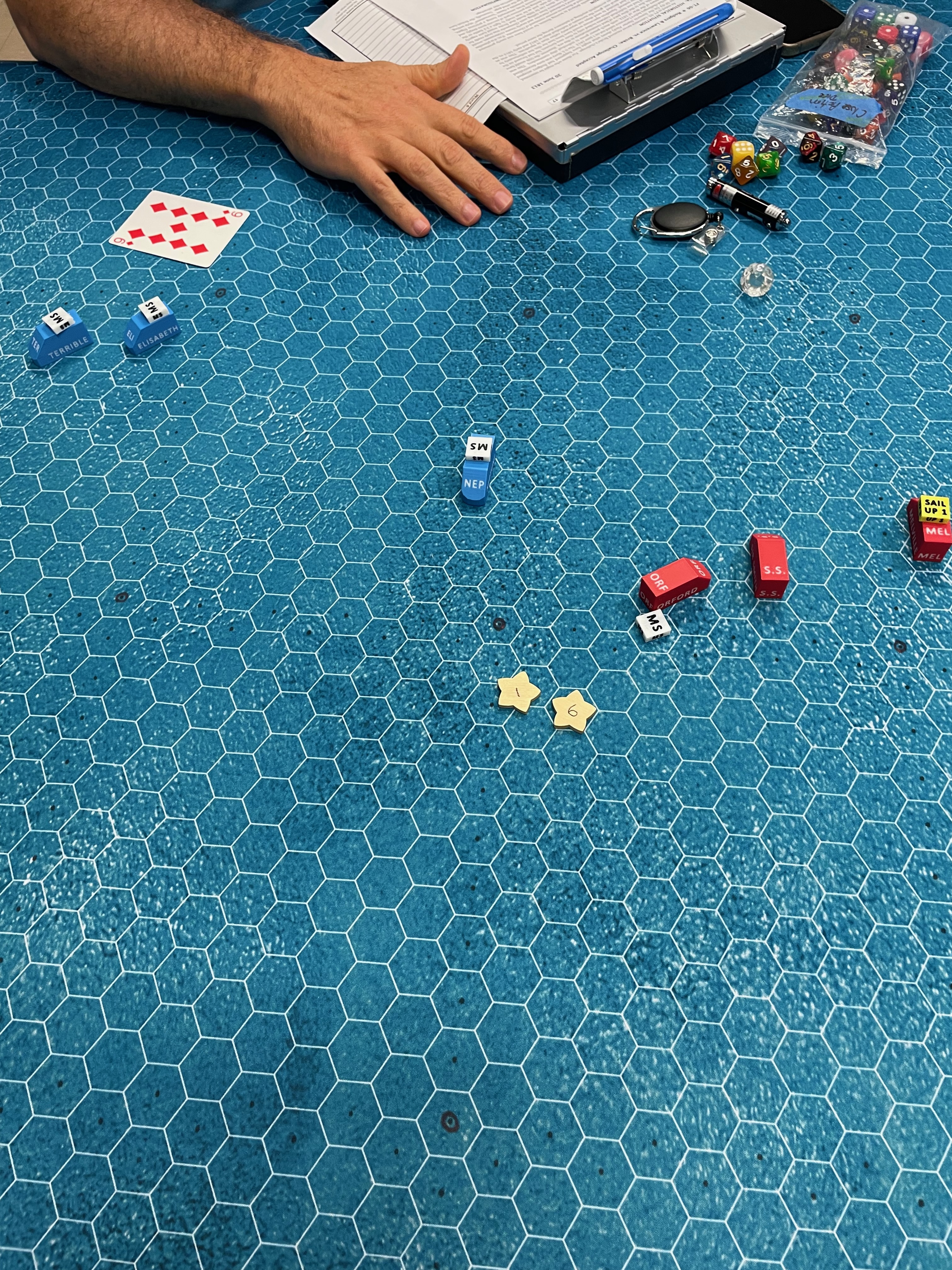
The squadrons begin circling each other. Orford's sail come down while Melville's go up.
Gunnery sees Neptune losing a hull box and a sailor box, while the British suffer no further damage.
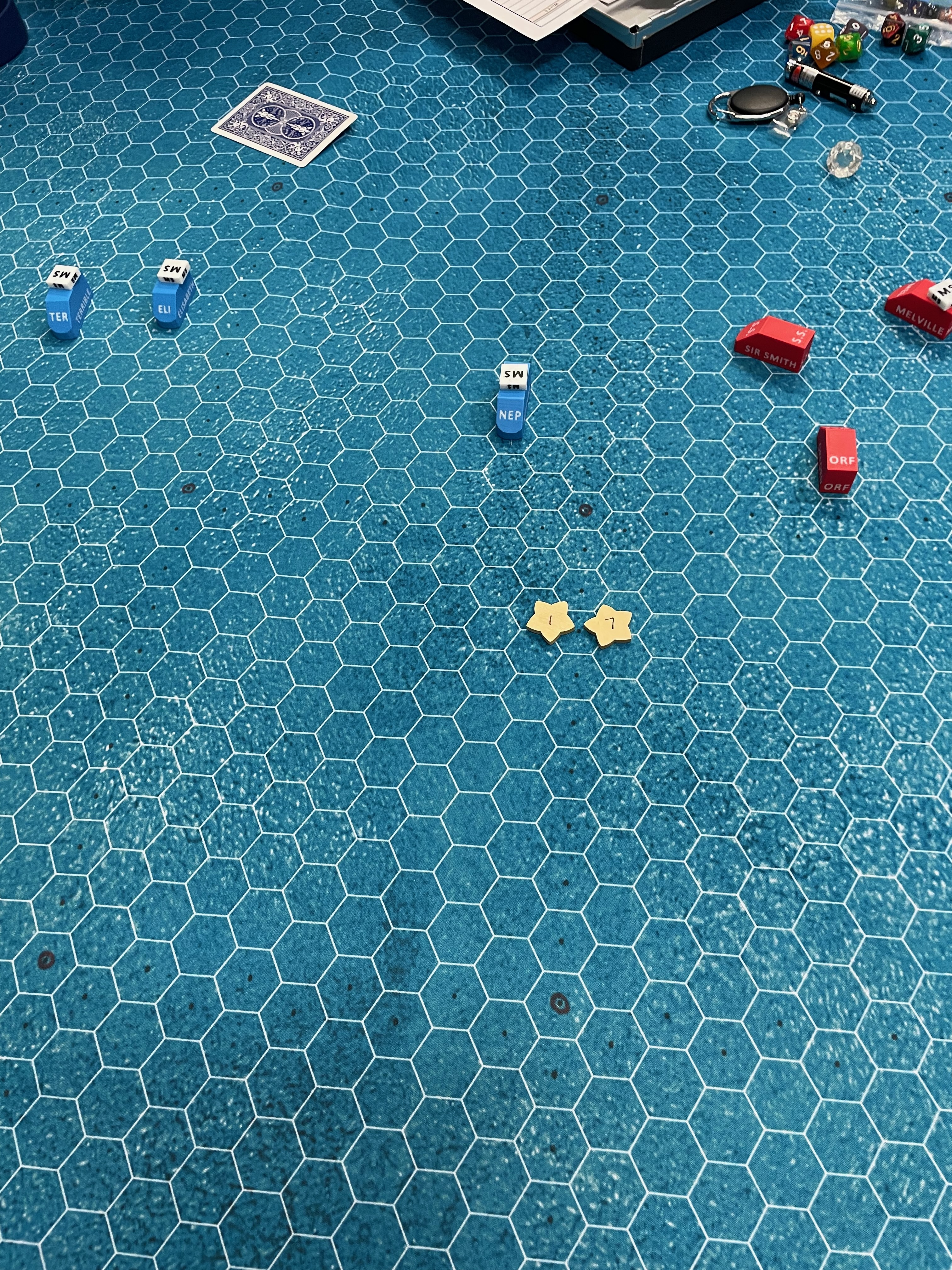
The circling continues. Sir Smith loses her first rigging section and has her wheel shot away, an irreparable critical hit which makes maneuvering more difficult. Neptune loses a rigging and a sailor box.
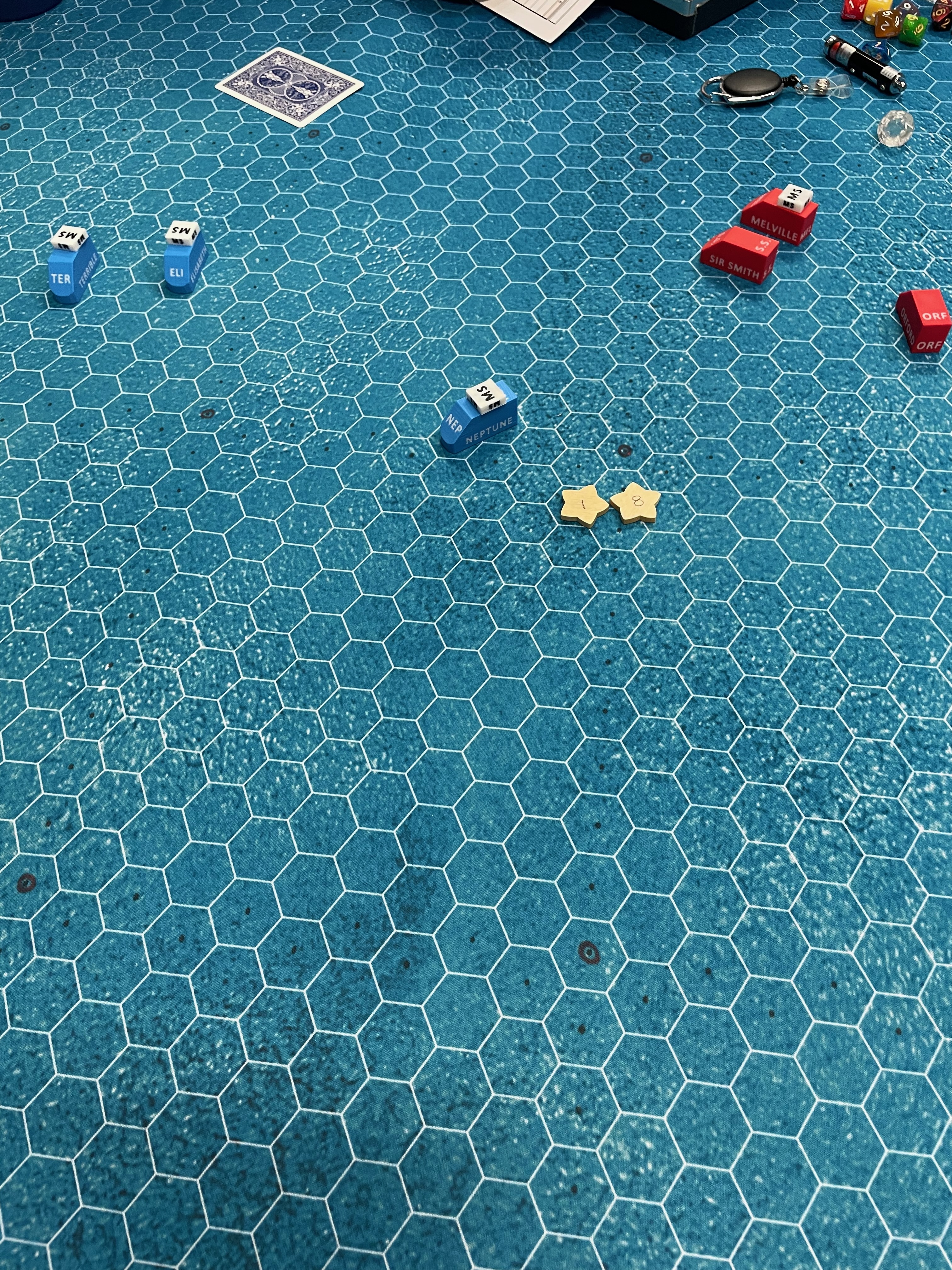
Neptune loses her first sailor section.
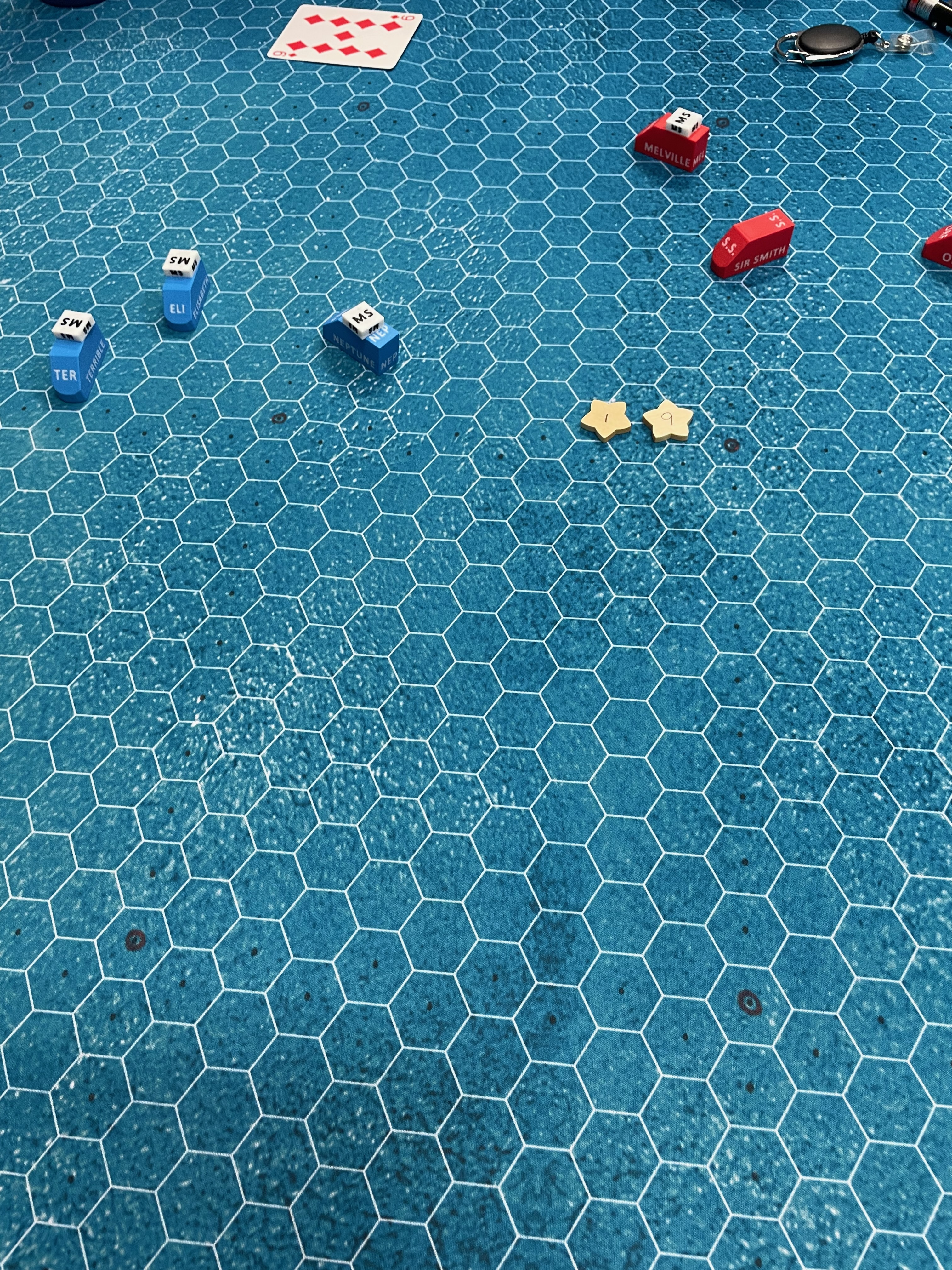
The Americans run. The British seem in no hurry to pursue. The only damage taken this turn is a sailor box on Neptune.
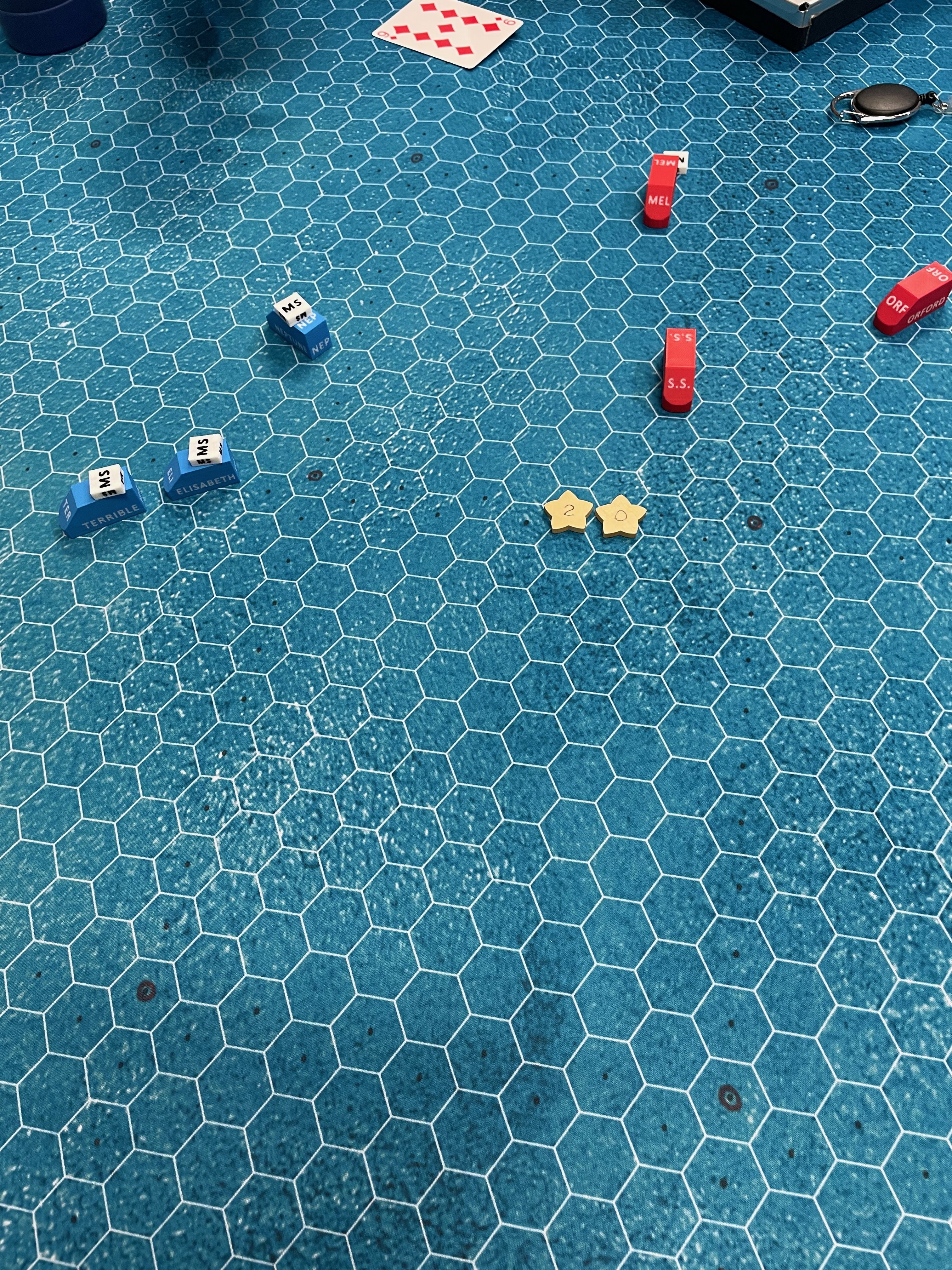
After a few turns of scrambling, the ships start migrating toward the usual parallel lines. Again the only damage is one of Neptune's sailor boxes.
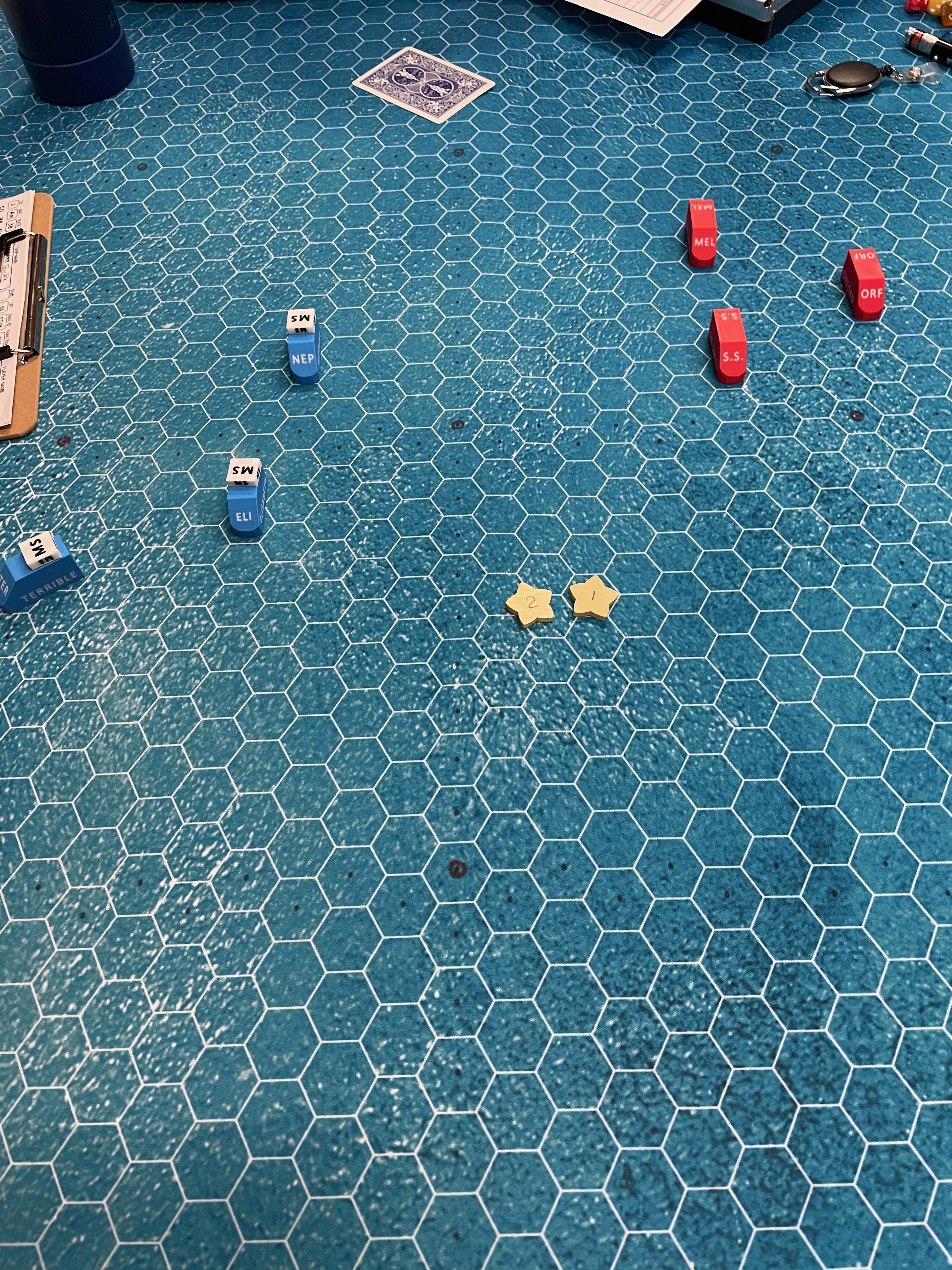
The formations begin coalescing. Neptune loses her first rigging section.
We played one additional turn for which I forgot to take a picture, then called it a night as it was getting late and no decisive action seemed immiment.
The final section losses (hollow circles indicate sections with just one box left):
| Ship | R1 | R2 | R3 | R4 | H1 | H2 | H3 | H4 | S1 | S2 | S3 | S4 | M |
| President (NEP) | ● | ● | |||||||||||
| Chesapeake (TER) | ● | ● | ● | ○ | |||||||||
| Congress (ELI) | ○ | ||||||||||||
| Shannon (S.S.) | ● | ||||||||||||
| Nymphe (ORF) | ● | ● | ● | ||||||||||
| Tenedos (MEL) | ○ | ● |
Tenedos originally lost her first rigging section, but repaired it during the game.
We did some quick victory point calculations at the end of the game and the score was very close, the British getting ~31 points to the American's ~27. Had Neptune's rigging section not fallen on the near-last turn, the Americans would have come out on top by a single point. It really could have gone either way had we continued.
This is an interesting scenario because all the ships are such high quality (A2, 3xB3, B4, C4), and the number of carronades makes short-range gunfire very effective. But these frigates look pretty fragile compared to ships of the line, especially in the often three-box sailor sections. So there's potential for a lot of lost sections happening quickly.
But the battle here was fought at generally moderate ranges, excepting the Terrible vs Orford duel during turns 7-13. And despite the quality, all of the B-level ships failed a morale check at some point during the game, which contributed to the weakening gunnery effectiveness as the game progressed. I think those factors are the reason for the relatively few lost sections during this game.
I didn't keep records on the luck factor, but my impression was that Lady Luck was pretty fair, the Americans landing a few more critical hits but the British perhaps scoring normal hits more consistently.
Thanks to all the participants!